Showing posts with label Book reviews. Show all posts

Sunday, October 27, 2024

Book Review: On the Edge, The Art of Risking Everything

(Image: https://www.penguinrandomhouse.com/books/529280/on-the-edge-by-nate-silver/)


I just finished Nate Silver's latest book and asked Gemini to summarize the mathematical, sports gambling and poker elements of the book.

Nate Silver's On the Edge is a fascinating exploration of risk-taking, particularly through the lens of mathematics, sports gambling, and poker. Silver, renowned for his statistical analysis and predictive modeling, delves into the world of high-stakes decision-making, examining how individuals and institutions can gain an edge.

A significant portion of the book is dedicated to the world of poker, a game where skill and probability intersect. Silver dissects the intricacies of poker strategy, highlighting the importance of understanding pot odds, implied odds, and the concept of expected value. He also explores the psychological factors that influence decision-making under pressure, drawing parallels to other high-stakes endeavors.

While the book touches on various aspects of risk-taking, its focus on mathematics and probability provides a rigorous framework for understanding uncertainty. Silver's ability to translate complex statistical concepts into accessible language makes the book engaging for both seasoned data enthusiasts and casual readers.

Ultimately, On the Edge is a thought-provoking exploration of the human capacity for risk and reward. By examining the strategies and mindsets of successful risk-takers, Silver offers valuable insights for anyone seeking to make better decisions in a world full of uncertainty.

In summary, I recommend the book. As I read it, I thought that readers not familiar with poker or sports gambling might get lost in some of the analogies that Silver outlines. However, he included an expansive glossary in the book to explain the terms he uses throughout the book.

Thursday, September 26, 2024

Happy Anniversary Rule 30


(Image: By Richard Ling - Own work; Location: Cod Hole, Great Barrier Reef, Australia, CC BY-SA 3.0, https://commons.wikimedia.org/w/index.php?curid=293495)

This year my wife and I are celebrating our 40th anniversary. This year Stephen Wolfram also celebrates the 40th anniversary of his favorite scientific discovery as he wrote in My All-Time Favorite Science Discovery

Also, see a prior post -https://www.blogger.com/blog/post/edit/8711601538345502519/636715033944644578.

This discovery led to Wolfram's publication of A New Kind of Science (now available online).

More on cellular automata: Triangular Automata.


Sunday, December 3, 2023

Book Review: Zero, The Biography of a Dangerous Idea by Charles Seife

(Image: https://www.ntskeptics.org/books/zero.gif)

Charles Seife, professor at New York University, wrote Zero, The Biography of a Dangerous Idea in 2000. Zero tells the story of how different cultures have used, or refused to recognize, the number zero in their mathematics. In telling this story, Seife also walks the reader through the history of mathematics including geometry, algebra, and calculus. A theme throughout the book is also the relationship of infinity and zero. In addition to the mathematical history, the book includes how zero and infinity link with many scientific concepts, including the future of the universe, absolute temperature, string theory, and quantum mechanics.

Monday, October 30, 2023

Book Review: Pluses and Minuses


Stefan Buijsman, philosopher of mathematics, earned his PhD at age 20. His book, Pluses and Minuses, How Math Solves Our Problems, covers several mathematical concepts in a very easy-to-read and understandable format. Many topics he reviews includes systems that we interact with everyday such as mapping the shortest route, Google searches, and Netflix movie recommendations. There are also examples of how mathematics models scientific observations and also predicts the possible existence of yet undiscovered phenomena. Most notable was Paul Dirac's prediction of the positron or anti-electron.

Another topic Buijsman writes is why early civilizations developed mathematics. Related to this topic, he also explains how certain indigenous cultures get by without having words for numbers. 

I particularly liked his chapter on probability and statistics. As an instructor of statistics myself, I will use Buijsman's examples in future classes.


Tuesday, October 17, 2023

Book Review: Gödel, Escher, Bach: an Eternal Golden Braid


I recently re-read Gödel, Escher, Bach: an Eternal Golden Braid, an epic book weaving the similar patterns found in mathematics, art/design, and music. First published in 1979, just a few years after the author, Douglas Hofstadter earned his PhD from the University of Oregon in 1975. I first read the Pulitzer Prize-winning book in 1983 while I was earning my PhD from the University of Illinois. So, I found it very inspiring that someone could produce such a great work early in his career.

In addition to the math of Gödel, the designs of Escher, and the music of Bach, Hofstadter includes dialogues between Tortoise and Achilles in the style of Lewis Carrol to reinforce the ideas he puts forward. He also includes a number of puzzles, discussions on computer coding, recursion (on many levels), and most interesting, artificial intelligence. 

Wednesday, August 30, 2023

Book Review: A New Kind of Science | Online by Stephen Wolfram


(Image: By Richard Ling - Own work; Location: Cod Hole, Great Barrier Reef, Australia, CC BY-SA 3.0, https://commons.wikimedia.org/w/index.php?curid=293495)


In 2002, Stephen Wolfram published A New Kind of Science (also known as NKS). It is based on the concept that relatively simple rules can create very complex systems. For the 20th anniversary, the book was made available free online: Stephen Wolfram: A New Kind of Science | Online—Table of Contents (wolframscience.com).

Before jumping in to read a 1000-page book on science, I suggest reading a few warm-up articles to help understand NKS:

John Conway's Game of Life: Conway's Game of Life - Wikipedia

and

Rule 30 - Wikipedia (one rule of many based on NKS that produces interesting results - perhaps the pattern shown in the photo of the shell shown above).

NKS touches on many different branches of science, including computing, randomness, physics, and nature.

More on cellular automata: Triangular Automata.


Tuesday, August 22, 2023

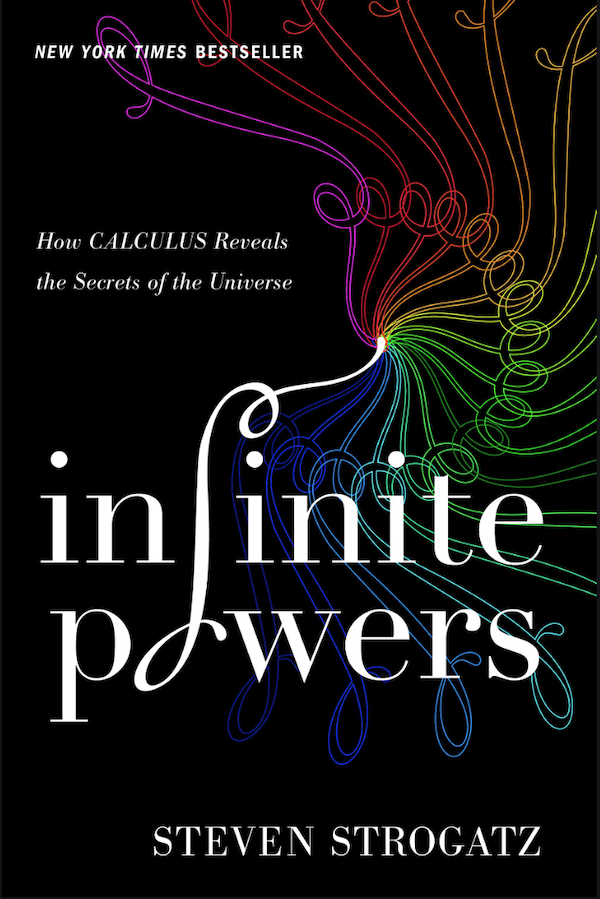
Book Review - Infinite Powers by Steven Strogatz


Who would think that one could write a book about calculus without having it filled with endless equations? Steven Storgataz, professor at Cornell University, accomplished this task masterfully in his 2019 book, Infinite Powers, How Calculus Reveals the Secrets of the Universe.

I wish I had had his clear explanations of calculus over forty years ago when I was a young student of mathematics. His book is filled with clear explanations and illustrations. He also has many applications in which calculus has been critical, such as the disease research, fingerprint analysis, space exploration, and music.


Friday, July 7, 2023

Book Review: The Math Book by Clifford A. Pickover


The Math Book, From Pythagoras to the 57th Dimension, 250 Milestones in the History of Mathematics by Clifford A. Pickover has an easy-to-read format. Each of the 250 entries is just two pages - one page with a description and brief history of the topic and one page with an illustration. The entries are listed chronologically and include famous mathematicians, discoveries, theorems, and conjectures. Topics from geometry, number theory, game theory, paradoxes, computing, set theory and more. In reading the entries, I found I could read several in a sitting or just one or two if I only had a little time. 

Wednesday, June 28, 2023

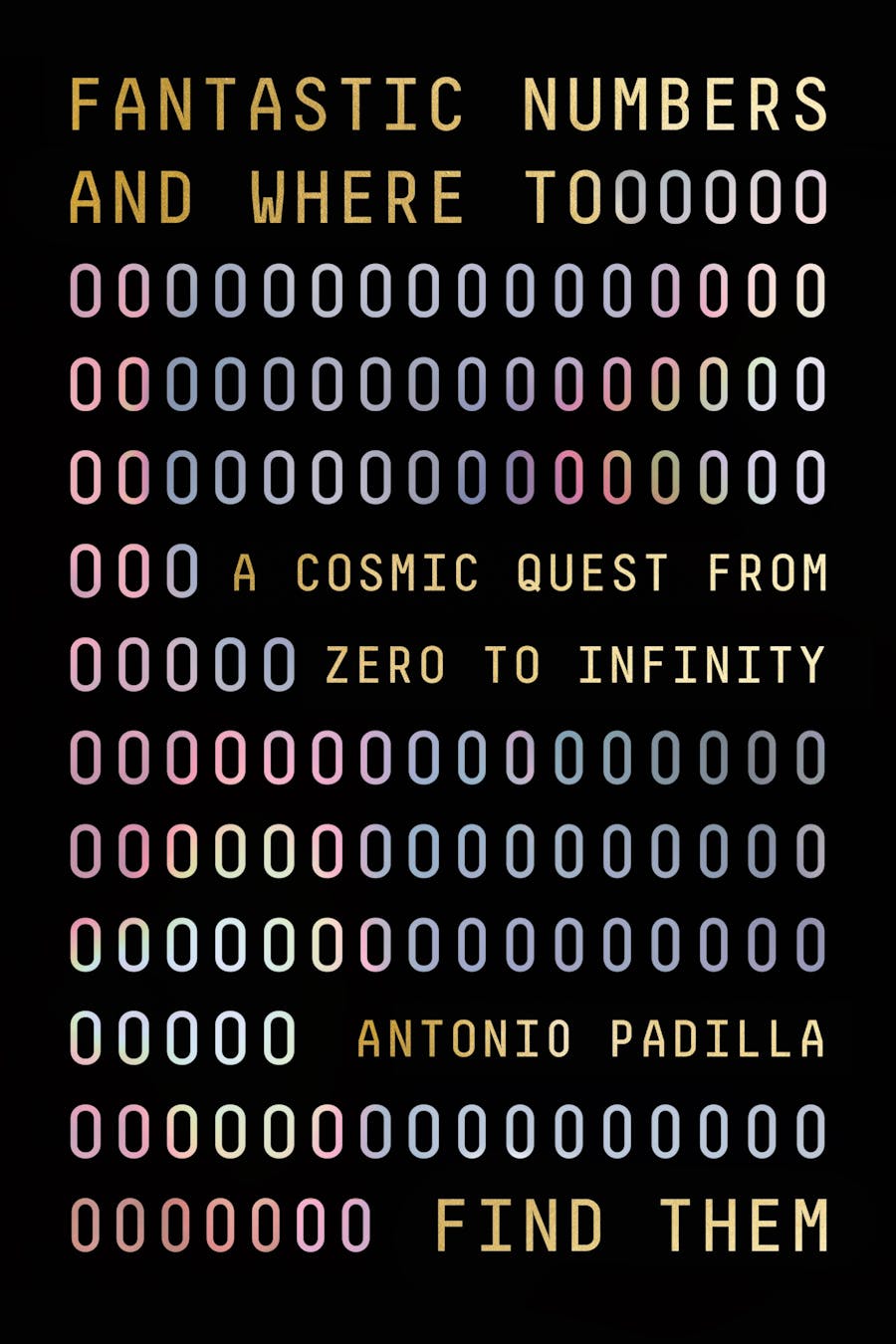
Book Review: Fantastic Numbers and Where to Find Them by Antonio Padilla


In 2022, Antonio Padilla published Fantastic Numbers and Where to Find Them, A Cosmic Quest from Zero to Infinity. Padilla is a theoretical physicist and cosmologist at the University of Nottingham. You may know him from his frequent appearances on the Numberphile YouTube channel.

The fantastic numbers that Padilla explores are those numbers associated with physics. The book is divided into three parts: Big Numbers, Small Numbers, and Infinity. He provides explanations with a variety of examples and stories. For instance, how sprinter Usain Bolt ages less than spectators in a stadium watching him because of time dilation. I also liked the discussion of how we may be living in a holographic universe.

Padilla reviews many scientific concepts including entropy, the Higgs boson, symmetry, black holes, and the theory of everything (TOE) without burdening the reader with excessive equations. 


Tuesday, October 18, 2022

Multiple Dimensions of Time


I’m currently reading a Robert Heinlein book, The Pursuit of the Pankera (The Pursuit of the Pankera | Arc Manor Books), in which a group of time-space travelers devised a machine to travel through parallel universes. The key to their machine is they discover that there are three dimensions of space and three dimensions of time. The book’s theme led me to look up how theorists have speculated that there may be more than one dimension of time.

There turns out to be quite several theories about multiple dimensions of time. Enough so there is a Wikipedia page dedicated to the topic: Multiple time dimensions - Wikipedia.

Some of theories include compact time dimensions analogous to the spatial dimensions of string theory, two time dimensions in which one is in real time and one is in imaginary time as with complex numbers, and multiple time dimensions similar to conventional time.

Beyond Heinlein, other popular authors have employed multiple time dimensions including C. S. Lewis (https://en.wikipedia.org/wiki/Chronicles_of_Narnia) and J. R. R. Tolkien (https://en.wikipedia.org/wiki/The_Lord_of_the_Rings).

Gunther Kletetschka, physicist - proposes that time has three dimensions and space is only its consequence - this theory could forever change the way we understand the universe https://share.google/wMBNWsoH2nVpGBByO


Update Nov 2026: https://www.sciencealert.com/a-strange-new-theory-helps-explain-why-our-universe-has-only-one-dimension-of-time

Tuesday, October 4, 2022

Geometry for dummies - A book review


In high school, I remember enjoying geometry class. It was in this class where most students first learn about proofs, and I liked the satisfaction of putting together solid proofs for theorems based a collection of given facts. Recently, I searched out for books to re-learn these skills. My first book selected from the local library was too advanced. I felt hugely disappointed in not being able to follow the first proof presented. I returned that book and found Mark Ryan’s Geometry for dummies in the same section.

Ryan’s approach is to introduce a concept and show a proof based on it. Then, he gives the reader a chance to apply the concept to another proof. He then walks the reader through longer proofs using multiple concepts earlier introduced. The author has a very clear way of explaining the ideas that makes this book easier to read (especially compared to the first book I checked out).

The book gives the basics and some more advance concepts on angles, triangles, polygons, circles and has an introduction to 3-dimensional geometry.

The author's biography says Mark Ryan practiced law for four years before deciding he should do something he enjoys. To me, this isn't surprising. In another post, I introduced a famous lawyer who improved his debating skill by studying Euclid: Math Vacation: Abraham Lincoln - A President Trained by Euclid (jamesmacmath.blogspot.com)

Book Website: Geometry For Dummies, 3rd Edition | Wiley

Saturday, September 24, 2022

Pythagorean Triple Generators - Part III


(Image: Iconfinder - Dea Jae on Iconfinder)

Two prior posts were made about Pythagorean Triples and an algorithm for producing triples (Part I, Part II).

I recently came across two additional algorithms for producing Pythagorean triples.

For reference my earlier post gave the first algorithm:

Let n and m be any positive integers where n>m. The Pythagorean Triple generated is formed by the numbers:
2nm
n
2 - m2
n
2 +m2

Below is another method.

Start with any odd number and square it.
Example: start with 3; 3x3 = 9

Next, find the two consecutive numbers that add up to the square of the starting number.

In this example, 4 + 5 = 9

The starting number, 3, and the two consecutive numbers, 4 and 5, will be a Pythagorean Triple (3,4,5).

Here’s another example:

Start with the odd number, 5. Square it: 25

Find the two consecutive numbers that add up to 25: 12 and 13

The Pythagorean Triple is (5, 12, 13)

Next is a third method which starts with any multiple of 4.

Example: 8
Take half of the starting number, 8 --> 4

Square this result, 4x4 = 16

Finally, use the two odd numbers immediately before and after this square: 15, 17

These two odd numbers and the original starting number will be a Pythagorean Triple (8, 15, 17)

One may use this method with even starting numbers that are not multiples of 4; however, the Pythagorean Triples produced can be reduced by a common denominator and will be found to be similar to a primitive triple. A primitive triple is one that cannot be reduced. For example, starting with 6; square half of 6 to get 3x3 = 9; use the numbers immediately before and after to get 8 and 10. The triple (6,8,10) is similar to the triangle (3,4,5). So, if you are trying to produce primitive triples, starting with multiples of 4, one will get triples that are irreducible triples. 


Here is a link to a spreadsheet I made for these different Pythagorean Triple generators: Pythagorean generator.  

Pythagorean Triples can also be found in the Online Encyclopedia of Integer Sequences: A001844 - OEIS

Reference: I read about these two additional Pythagorean Triple generators in the book Geometry for dummies by Mark Ryan. 

The site Math is Fun has good illustrations and further information on triples: Pythagorean Triples - Advanced (mathsisfun.com)

Additional formulae for producing triples are found on Wikipedia.

More interesting facts about Pythagorean Triples on Dr Ron Knott's archive.


Tuesday, September 13, 2022

Book Review: A divine language : learning algebra, geometry, and calculus at the edge of old age.


Alec Wilkinson, staff writer for The New Yorker magazine, recently wrote about his quest to study math later in life. Here is a link to his September 6, 2022, article: How Mathematics Changed Me | The New Yorker. He started his quest five years ago at age 65. He also writes about this in his book, A divine language : learning algebra, geometry, and calculus at the edge of old age. I have the book on order and look forward to reviewing it.

From his article, I understand much of what Wilkinson learned during his quest as I started this math blog late in my life. This blog started as a Covid project two years ago when I was 61. We both learned strangeness of different types of infinities, mystery of design of our world, and how God in unknowable.

11/8/2022 Update - my local library got this book, and I just finished it. Wilkinson included stories about many of my favorite mathematicians. I liked that he was able to interview Chris Ferguson, who won $1,000,000 in the World Series of Poker in 2000, shortly after earning his PhD from UCLA. 

Friday, September 9, 2022

Book Review: We Have No Idea, A Guide to the Unknown Universe by Jorge Cham and Daniel Whiteson


(Jacket design by Jorge Cham, Penguin Random House Riverhead Books)

If you are looking for an entertaining book on cosmology, We Have No Idea fits the bill. Authors Cham and Whiteson begin the book with a few chapters on what makes up the universe where we learn that it consists mostly of dark matter and dark energy. Fitting for the title of the book, scientists still know little about 95% of the universe.

To make the material easier to read, the book is generously illustrated by Cham with cartoon-style drawings.

Footnotes include science humor topics. For example, footnote 68 refers readers to the website: Has the Large Hadron Collider destroyed the world yet?

While providing a humorous example, I found their explanation of the difference of philosophical and scientific theories to be very easy to understand. Essentially, theories need to be testable to be deemed scientific.

 Another topic explored is string theory. Those who like the post, The Very Samll and the Very Big will like the chapter "How Many Dimensions are There?" 

Book’s website: We Have No Idea by Jorge Cham, Daniel Whiteson: 9780735211520 | PenguinRandomHouse.com: Books

Tuesday, June 7, 2022

The Doomsday Calculation


Consider answering the following questions:

How much longer will humans exist?

How long will a marriage last?

How much longer will that building be standing?

William Poundstone explains a simple approach to answering such questions in his book The Doomsday Calculation: How a Formula That Predicts the Future Is Transforming Everything We Know About Life and the Universe.

The Doomsday Calculation approach uses the Copernican principal which states that we are not in a special place (or time). Let’s take an example of you meet two couples for the first time at an event. The first couple has been together for a year, second couple for ten years. If you had no other knowledge of their relationships and you had to predict which couple would more likely be still together in a year, most people who probably pick the second couple. Your answer would be the same if you had to answer the question for being still together in five years or more. The first couple may be perfectly matched, but only given the evidence of the current length of their relationships, the second couple has demonstrated more longevity.

The Copernican principal states our observation of the couple is at no special time. In meeting the second couple who has been together ten years, we could be meeting them near the beginning of 70+ year marriage or we could be meeting them a year from a breakup, Let’s breakup the full (unknown) length of the relationship into quarters. We have a 25% chance of meeting them in the first quarter, a  50% chance of meeting them in the middle two quarters, and a 25% chance of meeting them in the final quarter.

The middle 50% is the range we’re interested in. If your meeting with them happens at the low end of this range, 25% of the length of their relationship has been ten years and they have another 75% or thirty years left. On the other hand, if ten years is the 75%, they only have another 25% left, which in this case is three years and four months remaining. With those two extremes evaluated, we can state we are 50% confident the relationship will last between three years and four months to thirty additional years.

Perhaps you want to state your range with a higher confidence level. That will mean widening the interval. Moving to 75% confidence, the interval becomes approximately a year and a half to seventy more additional years.

Poundstone gave a brief summary of the doomsday calculation with additional examples in: Doomsday argument: the end of humanity, predicted by a math equation - Vox


William Poundstone is the author of 16 books, including The Doomsday Calculation: How a Formula That Predicts the Future Is Transforming Everything We Know About Life and the Universe.

https://twitter.com/jamesmc10598530/status/1571565889853747206


Another article describing this calculation: https://interestingengineering.com/culture/surprising-question-about-our-place-in-time.


Friday, April 15, 2022

Book Review: Imagined Life by James Trefil and Michael Summers


This blog has had several posts linking how we use math to answer questions about space. 

Math Vacation: Book Review: Twenty Worlds by Niall Deacon (jamesmacmath.blogspot.com)

Math Vacation: How Many Black Holes are there in the Universe? (jamesmacmath.blogspot.com)

Math Vacation: Number of Planets in the Universe (jamesmacmath.blogspot.com)

Math Vacation: Can We Reach Another Star? (jamesmacmath.blogspot.com)

Math Vacation: How Far is it to the Next Nearest Planet with Interstellar Communication? (jamesmacmath.blogspot.com)

Math Vacation: One Equation - One or Many Worlds? (jamesmacmath.blogspot.com)

Authors James Trefil and Michael Summers put together a very good summary of the types of planets that exist in our universe that could support life. They classify these planets in the following ways:

Goldilocks – those planets like Earth that are just right distance from their star to have liquid water. This is our only confirmed source of life in the universe, so this very Earth-centric view is valid. However, they bring out that many other planet types could support life.

The other planet types explore in the book include:

Planets with surfaces of only solid ice.

Planets with surface ice and having liquid oceans below the surface.

Planets entirely covered with liquid water.

Planets that are in a tidal lock with their sun as our moon is with Earth.

Earth-like planets bigger than Earth but smaller than Neptune (none in our solar system, but very common elsewhere).

Planetary systems like those orbiting Trappist-1 where several planets are orbiting in close proximity to their star.

Most interestingly, are the rogue planets. These are planets that formed in solar systems and were ejected from the system by violent encounters during the solar system’s formation. Some believe that the number of rogue planets may far outnumber traditional planets. While they would not bathe in sunlight, they still have the source of energy from the cooling of their initial formation and from radioactive decay. Therefore, it is possible that these rogue planets could harbor life.

The book also discusses life forms that may exist outside of usual experience, including artificial intelligence and life based on electromagnetic basis versus a chemical basis.

Another important idea discussed is what other liquids, other than water, could be supportive of life. The main candidates include liquid methane, ammonia, and hydrogen sulfide.

Also explored is the possibility of life based on elements other than carbon, such as a silicon-based life.

Imagined Life: A Speculative Scientific Journey among the Exoplanets in Search of Intelligent Aliens, Ice Creatures, and Supergravity Animals: Trefil, James, Summers, Michael: 9781588346643: Amazon.com: Books


Thursday, March 17, 2022

Book Review: The Art of Statistics by David Spiegelhalter


I’ve read many books about mathematical subjects in search for new ideas and new ways to explain concepts to my students. Writing an easy-to-read book about math is not easy and writing an easy-to-read book about statistics is much more difficult, but David Spiegelhalter of the University of Cambridge succeeded in this task. While most mathematical topics deal with proofs that provide absolute facts, statistics is more difficult because it deals with uncertainty and error.

Spiegelhalter’s walks the reader through different types of data, descriptive statistics, inferential statistics, correlation, hypothesis testing and the use of Bayesian statistics without getting bogged down with equations. Instead, he focuses on using real-life case studies and just enough graphics to help the reader understand the concepts.

I particularly liked his suggestion in teaching probability and statistics, to postpone the challenging section of probability to later in the course rather than at the beginning. I also liked his liking of using the Bayesian way of estimating probabilities (see prior post: Math Vacation: Thomas Bayes - an Attempt to Prove the Existence of God (jamesmacmath.blogspot.com)).

Book website: The Art of Statistics by David Spiegelhalter | Basic Books

Meet David Spiegelhalter on YouTube: (1352) The Art of Statistics with Professor Sir David Spiegelhalter - YouTube


Saturday, March 12, 2022

Book Review: Twenty Worlds by Niall Deacon


(Cover image credit: Simon McFadden/Reaktion Books)

In Twenty Worlds, The Extraordinary Story of Planets Around Other Stars, Niall Deacon writes about twenty different exoplanets. As discussed in a prior post (Math Vacation: Number of Planets in the Universe (jamesmacmath.blogspot.com)) in this blog, it has been a bit more than thirty years since the first exoplanet was discovered and in that short period of time, thousands have been catalogued.

In the twenty that Deacon describes, he gives us a nice mixture of large, gas giant Jupiter-like planets and smaller, Earth-like planets. His explanations of the various methods of detecting exoplanets are clear and supplemented with well-done illustrations.

Thirty years ago, only the largest of exoplanets could be detected, but now with space-based telescopes and improved technologies for earth-based telescopes, all sizes of exoplanets are becoming detectable and, in some cases, directly observable.

Website: Twenty Worlds by Niall Deacon

Related posts: Math Vacation: How Many Black Holes are there in the Universe? (jamesmacmath.blogspot.com)

Math Vacation: Number of Planets in the Universe (jamesmacmath.blogspot.com)


Sunday, February 20, 2022

Book Review: Humble Pi - When Math Goes Wrong in the Real World by Matt Parker


Matthew Parker is an author, stand-up comedian, science communicator and former mathematics teacher. He is a frequent guest on the Numberphile podcasts and Numberphile YouTube videos. In his recent book, Humble Pi – When Math Goes Wrong in the Real World, Parker explores mistakes made by humans and systems. He reviews many tragic mistakes, such as medical deaths, airplane accidents and rocket failures, resulted from simple errors such as decimal point errors, typos, mistaken units of measure. Also explained are common computing errors. I liked his chapter dedicated to the difficulty to producing random numbers and the various mechanical and numerical methods of doing so.

Book site: Humble Pi by Matt Parker: 9780593084694 | PenguinRandomHouse.com: Books

Related Links:

Matt Parker | Standup Mathematician (standupmaths.com)

YouTube: matt parker - YouTube


Thursday, February 3, 2022

Book Review – Instant Mathematics by Paul Parsons and Gail Dixon


In Instant Mathematics, Key Thinkers, Theories, Discoveries and Concepts, Paul Parsons and Gail Dixon put together a very easy to read collection of 160 lessons, each explained on a single page. The lessons cover both mathematical concepts and mathematicians. The book is chronologically starting with the discovery of the oldest known mathematical artifact, the Lebombo bone (found with counting tally marks) and ending with modern day analytics.

The illusrations are clear and supplement the concepts reviewed. As a material science engineer, I particularly liked the lesson on Kepler’s Conjecture which asserts the most efficient way to pack spheres in a volume. Also see the post in this blog: Math Vacation: Atomic interstitial sizes in higher dimensions (jamesmacmath.blogspot.com).

A few of the lessons cover cryptography, including examples from ancient Mesopotamia and Greece and ending with modern quantum algorithms. In a prior post I propose a much less sophisticated method - Math Vacation: One-Time Pad Coding and a Proposal for Improvement (jamesmacmath.blogspot.com).

The book is part of Simon & Schuster series called Instant Knowledge.

Instant Mathematics | Book by Paul Parsons, Gail Dixon | Official Publisher Page | Simon & Schuster (simonandschuster.com)


16670, A Saintly Number

  (Image: By Unknown author - http://santuarioeucaristico.blogspot.hu/2010/08/sao-maximiliano-kolbe-14-de-agosto.html, Public Domain, https:...

Popular in last 30 days